Competency-Based Assessment

Competency-Based Assessment: Key Advantages and Disadvantages

Competency-based assessment has become one of the most effective methodologies for selecting, developing, and managing talent. Instead of focusing solely on degrees, years of experience, or technical skills, this type of assessment examines how a person behaves in real workplace situations based on observable and measurable behaviors.

However, while it offers significant benefits, it can also present challenges if it is not implemented carefully. In this article, we explore what competency-based assessment is, its main advantages, potential disadvantages, and how to maximize its results so your hiring process is fairer, more effective, and more focused on future performance.

Dos hombres con vestimenta de negocios se dan la mano a través de una mesa. Un documento yace frente a ellos, implicando un trato exitoso. Ambos sonríen, mostrando acuerdo.

What Are the Advantages of Competency-Based Assessment?

Competency-based assessment offers multiple benefits for both Human Resources teams and the organization as a whole:

It Creates a Better Match Between the Role and the Candidate

Unlike superficial assessments that focus only on experience or technical knowledge, competency-based assessment helps identify how a candidate thinks, behaves, and solves problems in real work-related situations.

This results in:

  • A greater likelihood of success in the role.
  • Fewer hiring mistakes based on impressions.
  • Better alignment between performance and role expectations.

It Increases Objectivity in the Process

By using clear and comparable criteria, it reduces the impact of subjective biases. Traditional interviews and assessments may be influenced by personal preferences or first impressions, while competency-based assessment establishes measurable standards.

It Improves Talent Development and Management

It is useful not only for recruitment, but also for creating personalized training plans, identifying performance gaps, and designing career development paths for current employees.

It Integrates Well with Other Assessment Tools

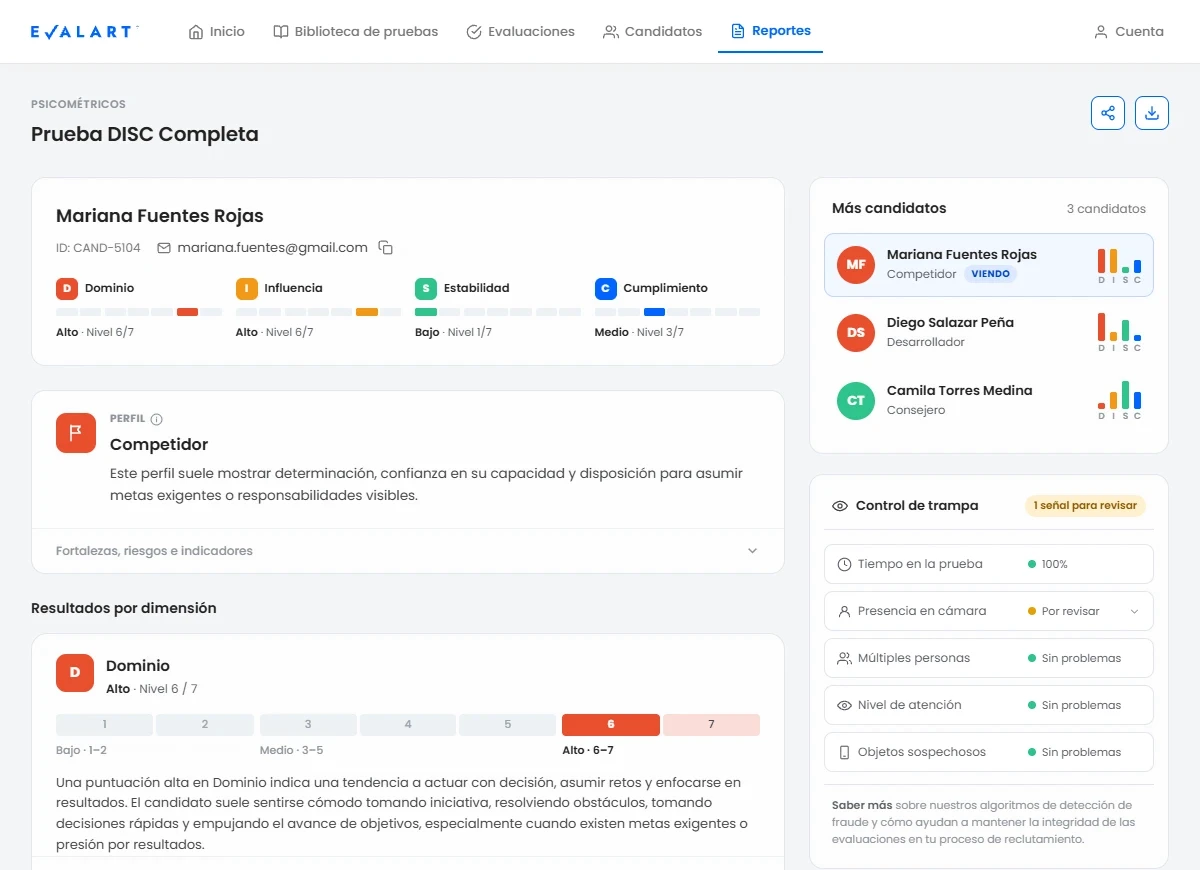
You can combine competency-based assessment with psychometric and technical tests to gain a more comprehensive view of the candidate. For example:

  • Personality and work-style tests
  • Logical reasoning assessments
  • Attention-to-detail tests

This multi-assessment approach enables more accurate and comparable decisions. Learn more about psychometric tests in this article.

It Helps Standardize Recruitment Processes

Designing a competency-based assessment requires your team to define which behaviors are relevant to each role. This creates greater consistency across evaluators and processes, especially when several recruiters or department leaders are involved.

You can also make your process more robust by incorporating digital assessment tools, such as the available tests on Evalart.

And if you have not tried the platform yet, you can start with a free trial today.

Competency-Based Performance Assessment: Advantages and Disadvantages

Although competency-based assessment offers many clear advantages, there are also certain aspects you should consider in order to implement it effectively.

Main Advantages

Greater accuracy in hiring decisions: Unlike processes based solely on interviews, it helps identify actual skills and behavioral tendencies.

Better alignment with organizational goals: When each competency is clearly defined, it can be directly linked to what the company needs to achieve its objectives.

Promotes internal fairness: By standardizing assessment criteria, all candidates go through the same process, helping reduce bias.

Useful for internal development and existing talent: It is valuable not only for attracting new talent, but also for assessing potential and career development plans.

Disadvantages or Challenges to Consider

More time required for design and preparation: Creating a solid competency-based assessment requires effort, including defining relevant competencies, assessment metrics, and guidelines for interviewers.

Evaluator training is necessary: Leaders and recruiters must be trained on how to conduct and score competency-based interviews to avoid incorrect interpretations.

Potential for bias if poorly implemented: If the criteria are not clearly defined or evaluators are not properly trained, the assessment may become subjective.

Requires ongoing review: You need to periodically review whether the defined competencies are still relevant to the business or need to be adjusted.

Dos hombres están sentados en una mesa de conferencias, sonriendo y conversando. El fondo presenta una pared de color amarillo brillante, creando una atmósfera alegre y animada.

Tips to Maximize the Advantages and Minimize the Disadvantages

Define Competencies Based on Data

Use past performance analysis and feedback from managers to identify which behaviors truly have an impact on results.

Create Clear Assessment Guidelines

For each competency, define examples of expected and unexpected behaviors. This helps multiple evaluators reach similar conclusions.

Combine It with Other Assessments

Although competency-based assessment is powerful, the best approach is to integrate it with objective tests such as psychometric, technical, and aptitude assessments. This provides a more complete view of the candidate.

You can do this with platforms such as Evalart, which allow you to integrate different types of assessments into a single recruitment workflow. Learn how it works.

Train Your Team

Provide training for those who will administer these assessments, including practical examples, calibration exercises, and reviews of common biases.

Competency-based assessment is a valuable tool for talent selection and development because it helps identify a candidate’s or employee’s skills, behaviors, and potential more accurately. Its advantages are clear when implemented rigorously, but it is also essential to recognize its challenges in order to maximize its impact.

If you want to strengthen your hiring process with consistent, objective assessments aligned with your organizational strategy, consider combining competency-based assessment methods with other tests available on modern platforms such as Evalart.

Start improving the quality of your talent decisions today. Request a free trial or learn more about our platform.

Other similar news articles

How to Test Salesforce Skills in Interviews | Salesforce Interview Questions

How to Test Salesforce Skills in Interviews Recruiting top Salesforce professionals is essential for businesses that use the platform extensively. Whether it's configuring workflows, integrating…

Read More
The Importance of Online Testing for Today’s Agile Workforce

The Importance of Online Testing for Today's Agile Workforce In an era where agility and adaptability have become key differentiators for a successful modern workforce,…

Read More
Top 5 Interview Questions for Marketing Interns

In the fast-paced world of marketing, hiring the right intern can make a significant difference to your team’s productivity and success. But the challenge is…

Read More