Key psychometric tests for your recruitment process

Key Psychometric Tests | Hire the Right Talent

Are you looking for a more effective way to choose the best talent from the beginning of the selection process? Job-related psychometric tests allow you to make more accurate decisions by objectively evaluating candidates’ skills, aptitudes, and even personality traits.

The process of selecting a new team member typically involves resources before and during the selection process, representing a significant investment of time and effort. Companies seeking efficient processes and successful hires are focusing on incorporating comprehensive tools that streamline recruitment.

The main tools are psychometric testing platforms that provide a complete profile and analysis of candidates.

Unlike a traditional interview, a properly administered psychometric test can reveal key aspects of candidates’ workplace behavior, thinking style, and cultural fit. This way, you not only reduce the margin of error when hiring, but also find people who truly align with your company.

Psychometric tests are not a new resource; they are a tool that emerged in Paris in 1870 with Professor Alfred Binet, who used them to identify the most intelligent students. However, the field and the way these tests are applied have evolved significantly, along with their effectiveness in recruitment processes.

Evalart puts these tools within reach of your recruitment team through an intuitive, secure, and reliable platform, adapted to the needs of the Latin American market. With our online psychometric tests, you can automate part of the assessment process without losing depth in the analysis.

In this article, we explain everything you need to know about psychometric tests, the different types of tests available, and what each one is used for.

Start today with a free trial or explore our complete catalog of psychometric tests designed by experts in workplace assessment.

What is a psychometric test?

A psychometric test is a standardized tool that allows the evaluation of an individual candidate’s characteristics, such as intelligence, reasoning, cognitive abilities, personality, and more.

In the workplace context, they are used to predict professional performance, identify the level of compatibility with a specific role, and support decision-making in recruitment processes.

These tests, which can range from a personality test to a technical psychometric exam simulator, are applied at different stages of the recruitment process to filter profiles and better understand each person’s true potential beyond their résumé.

A job-related psychometric assessment is based on objective and measurable criteria, making it a valuable tool for recruiters and human resources managers who seek accuracy, speed, and a fairer process.

Graphic design by Marino

Psychometric tests: What do they include?

Psychometric tests are tools designed to measure different aspects of human behavior in a standardized and objective way. In the workplace, these tests are used to evaluate whether a candidate has the necessary characteristics to successfully perform a specific role.

There are different types of tests, each focused on measuring specific areas such as:

  • Cognitive abilities: verbal reasoning, numerical reasoning, abstract reasoning, working memory.
  • Personality traits: level of responsibility, emotional stability, adaptability.
  • Technical skills: job-specific knowledge, such as programming or accounting.
  • Cultural fit: candidate values, motivations, and work style.

Applying these tests helps reduce subjectivity in the hiring process, increasing the likelihood of selecting the right person for the position and the team.

Evalart offers a wide variety of preconfigured and customizable workplace psychometric tests tailored to your company’s needs. (Catalogue link or button here)

Objectives of psychometric tests

Workplace psychometric tests have a clear purpose: to provide objective and comparable data that facilitates decision-making in recruitment processes.

Instead of relying solely on interviews or résumés, these tests provide an additional layer of analysis that improves the quality of hiring decisions.

Main objectives of psychometric tests:

  • Identify a candidate’s true potential. It is not enough to know if someone has experience: do they have the ability to learn, adapt, and solve problems? Will they be able to easily fit into the company culture and work effectively as part of a team?
  • Reduce hiring bias. Standardized tests allow all candidates to be compared under the same conditions.
  • Predict future performance. Studies show that certain aptitudes and traits are highly predictive of success in the workplace.
  • Streamline the selection process. With a single assessment, you can filter out up to 80% of applicants and focus only on the most suitable candidates.
  • Improve cultural fit. A good hire not only fulfills the responsibilities of the role but also integrates into the team and company culture.

A good hiring manager uses psychometric tests to:

  • Assess soft skills and hard skills more accurately before the interview.
  • Save time in high-volume recruitment processes.
  • Establish a unified evaluation criteria among multiple interviewers.
  • Have greater confidence in the final decision, supported by concrete data.
  • Reduce employee turnover by ensuring better compatibility with the role and work environment.

What do psychometric tests measure?

Workplace psychometric tests are designed to evaluate a combination of skills, aptitudes, knowledge, and personality traits that directly influence a candidate’s performance in the work environment.

These assessments make it possible to go beyond experience or professional qualifications and focus on what truly matters: how a person thinks, reacts, and performs in real workplace situations.

Areas evaluated by psychometric tests:

  • Cognitive abilities: logical reasoning, attention, memory, verbal analysis, and numerical analysis.
  • Problem-solving ability: speed, accuracy, and critical thinking when facing new situations.
  • Personality traits: emotional stability, responsibility, openness to change, leadership, among others.
  • Emotional intelligence: skills to work in teams, manage stress, and adapt to changing environments.
  • Technical knowledge: Depending on the role, practical assessments can be included in areas such as programming, sales, customer service, and more.

How to Apply Psychometric Tests Effectively?

A psychometric assessment is only valuable if it is applied correctly. To ensure the results are truly meaningful and help you make better hiring decisions, it is essential to integrate psychometric tests strategically into your recruitment process.

Best practices for applying psychometric tests:

1. Define the job profile: Before administering any assessment, make sure you have a clear understanding of the role’s requirements. (Job description)

2. Choose the right type of assessment: Use aptitude, personality, or technical tests based on the key competencies you want to evaluate. These are some of the most widely used assessments in effective recruitment processes. (Catalogue link)

Leadership Test: This type of assessment evaluates a person’s ability to influence others, make strategic decisions, communicate effectively, and manage teams.

What does it measure?
– Leadership styles (authoritative, participative, delegative, etc.)
– Decision-making skills
– Ability to manage conflicts and motivate others.

Who is it recommended for?
Ideal for supervisory, coordination, management positions, or any role that requires direct leadership of a team.

Explore the leadership assessments available at Evalart.

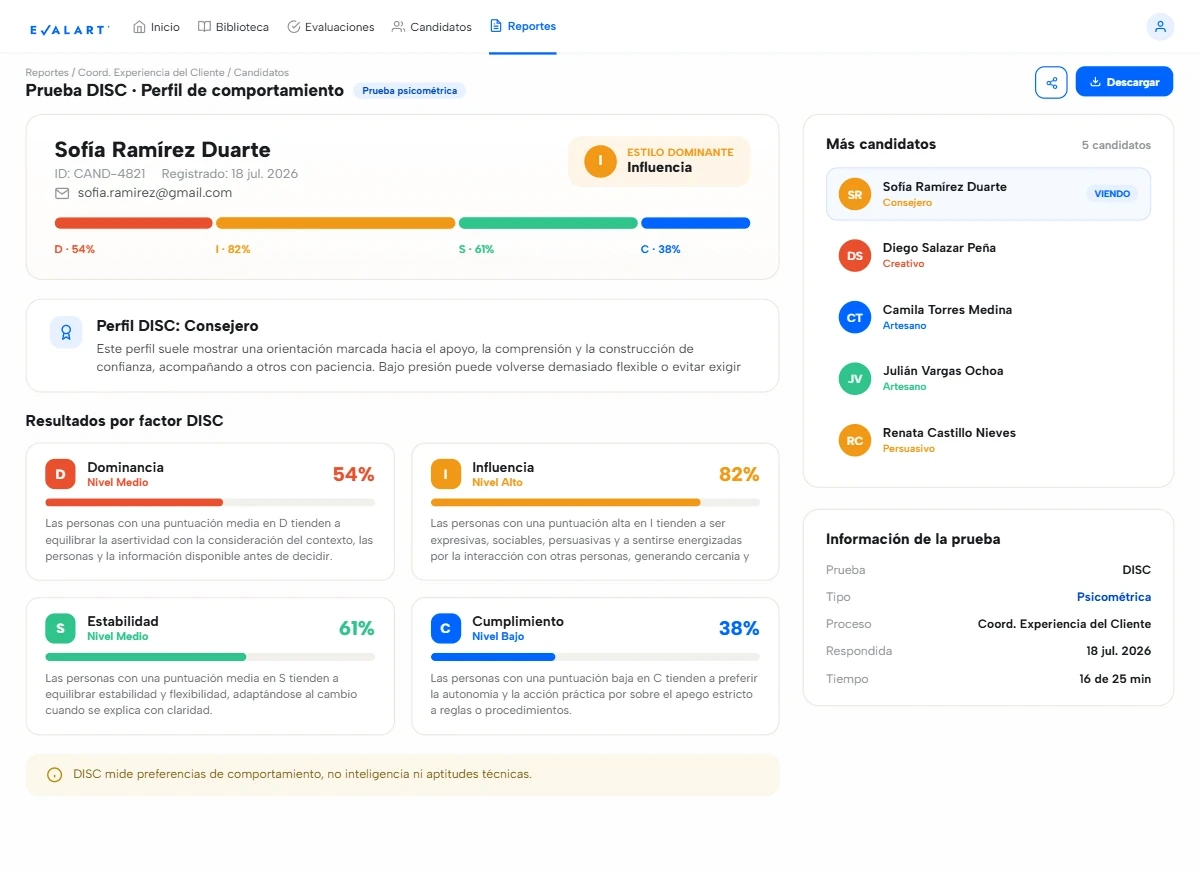
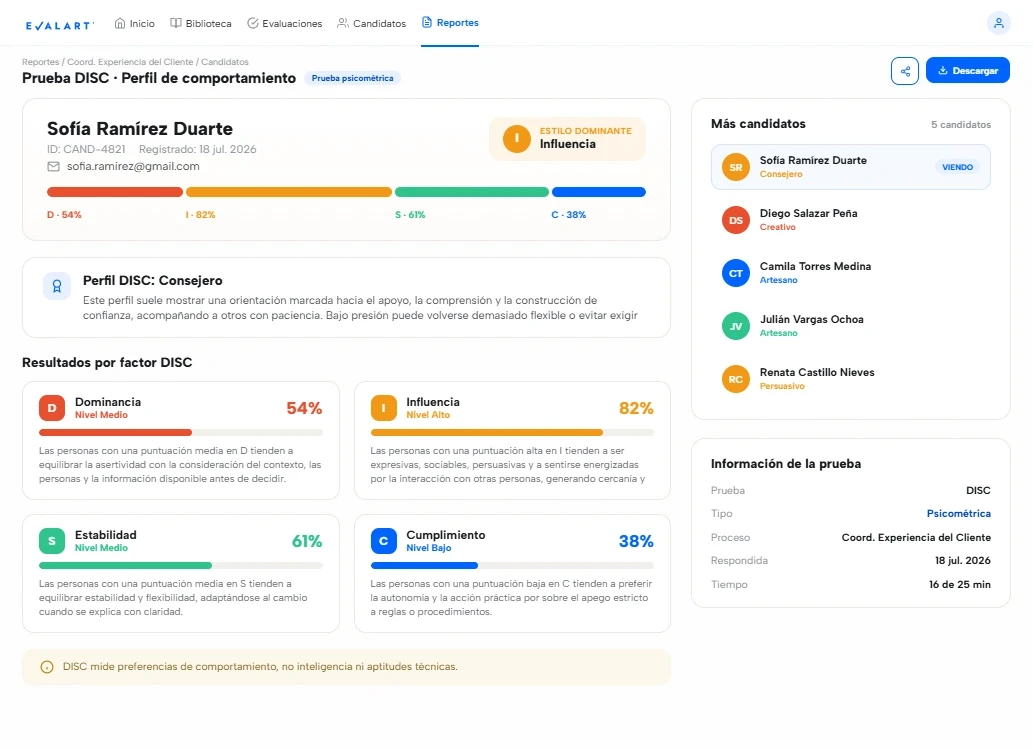
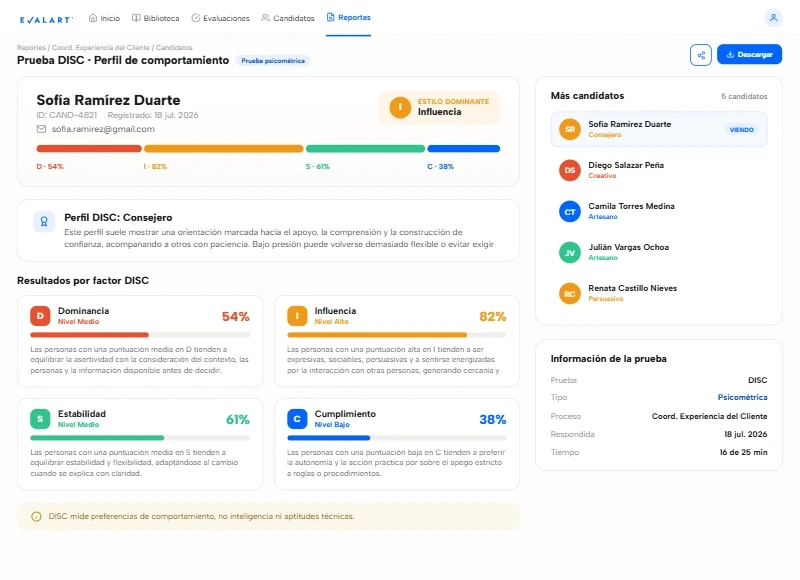
DISC Test: The DISC Assessment is one of the most widely used psychometric evaluations for understanding candidate behavior in professional contexts. It evaluates four key behavioral dimensions: Dominance, Influence, Steadiness, and Compliance, providing a clear view of communication style and how individuals respond to different workplace situations.

What does it measure?
– Reactions under pressure
– Communication style and motivational factors
– Compatibility with different work environments and team dynamics.

Who is it recommended for?
It is especially useful for administrative, sales, customer service, and mid-level management positions, where interaction with others, collaboration, and adaptability are key factors for success.

Learn more with Evalart’s Complete DISC Assessment.

Complete Intelligence (IQ) Test: Evaluate Overall Cognitive Potential

Evalart’s Intelligence Test is designed to measure different dimensions of reasoning, providing a reliable estimate of a candidate’s intelligence quotient (IQ). Through exercises covering logical, numerical, verbal, and spatial reasoning, this assessment provides a clear view of candidates’ cognitive potential.

What does it measure?
– Mental agility and abstract reasoning
– Problem-solving ability
– Verbal comprehension and numerical analysis.

Who is it recommended for?
Ideal for analytical or technical roles such as software developers, data analysts, engineers, and senior administrative positions, where decision-making and critical thinking are essential.

Learn more about Evalart’s Complete Intelligence (IQ) Test.

3. Integrate the assessment into the hiring process from the beginning: Do not wait until the final stage to evaluate candidates. Using assessments early in the process allows you to filter applicants from the first interaction and save valuable time.

4. Automate the process: Use platforms like Evalart to send assessments, monitor responses, and obtain results automatically.

5. Interpret results carefully: Psychometric assessments should not be considered an absolute truth, but rather an additional resource to support informed decision-making.

How to Choose the Right Psychometric Test for Each Role Profile

Selecting the right psychometric assessment depends not only on the position requirements, but also on the stage of the hiring process, the recruitment strategy, and the indicators that truly influence long-term performance. Here is a deeper approach to making better decisions:

1. Define what you need to predict

Not all assessments are designed to predict performance. For example:

  • Intelligence tests, such as the Complete Intelligence (IQ) Test, are excellent predictors of learning speed and adaptability. They help anticipate how quickly a new employee can acquire knowledge, solve problems, and take on new responsibilities.
  • Personality tests, such as the Big Five or DISC, help predict aspects such as compatibility with the organizational culture, leadership style, and how an individual handles challenges and collaborates within a team.
  • Situational judgment tests allow organizations to evaluate behaviors in key scenarios.

🔎 Choose the assessment based on the success metric you want to anticipate: Productivity? Adaptability? Retention?

2. Integrate your historical hiring data

If you already have information about the characteristics that define your best employees, use it as a reference. For example:

  • If your top salespeople have high scores in extraversion and resilience, prioritize assessments that measure these dimensions.
  • Evalart allows you to compare current candidates’ results with previous averages to refine your screening process.

3. Adapt the difficulty level to the labor market

In contexts where talent is scarce, applying overly demanding assessments at the beginning can discourage strong candidates. Adjust the level and type of assessments according to:

  • The competitiveness of the role
  • The urgency of hiring
  • The stage of the process (for example, a light assessment as an initial filter and a more comprehensive one in the final stage)

4. Avoid Biases with Smart Combinations

A single assessment may favor certain profiles or cognitive styles. To avoid biases:

  • Combine objective assessments (such as aptitude tests) with subjective assessments (such as personality tests).
  • Alternate between formats: multiple choice, open-ended responses, video questions, etc.

5. Evaluate the Candidate Experience

The assessment also communicates something about your employer brand. Make sure that:

  • It is clear and user-friendly in its format.
  • It has a reasonable duration.
  • Provide clear feedback — Evalart offers automated and customizable reports.

Benefits of Psychometric Assessments

Workplace psychometric assessments offer multiple benefits for companies looking to optimize their recruitment process and hire the right talent from the start.

Why Should You Use Psychometric Tests in Your Company?

Data-driven decisions, not assumptions: Objectively assessing skills, aptitudes, and personality traits enables companies to make informed decisions and reduce the risk of hiring based on intuition.

More efficient selection processes: By automatically filtering out candidates who do not meet the required profile, the number of interviews needed can be reduced by up to 80%.

Better candidate–job fit: By understanding the applicant’s behavioral and cognitive profile, companies can evaluate whether they are truly a good match for the role and the organization’s culture.

Increased productivity and reduced turnover: Hiring the right profile from the start reduces onboarding time, improves performance, and minimizes the risk of early employee turnover.

A more professional and transparent recruitment experience: Having structured assessments creates a better impression among candidates and standardizes the evaluation process.

Disadvantages of Psychometric Assessments

Although workplace psychometric assessments offer significant benefits, it is also important to consider their potential limitations in order to apply them thoughtfully and strategically.

Key Considerations

  • They should not be the only selection criterion: An effective psychometric assessment complements the hiring process but does not replace interviews, references, or a review of the candidate’s work history.
  • Misuse or misinterpretation of results: Without trained personnel or tools that provide clear reports, there is a risk of incorrectly interpreting results and making poor hiring decisions. (Features or How it works link)
  • Candidate rejection: Some applicants may feel uncomfortable or discouraged if assessments are not properly explained or seem unrelated to the role.
  • Risk of unreliable assessments: Using tests without scientific validation can do more harm than good. It is important to choose platforms that have professional and technical support behind their evaluations.
  • Poor investment of time and resources: When there is no clear understanding of what needs to be measured or how the information will be integrated into the hiring process, assessments can become a waste of time.

How to Use Psychometric Assessments to Improve Hiring

Strategically applying workplace psychometric assessments can transform your recruitment process and help you make more objective, accurate, and faster decisions.

Best Practices for Effective Implementation

  1. Clearly define the job profile: Before choosing a psychometric assessment, identify the skills, knowledge, and personality traits most relevant to the role. This allows you to select the right test and customize it when necessary.
  2. Use reliable and specialized tools: Make sure to apply assessments with proven psychometric validity and that align with industry standards.
  3. Integrate assessments into the selection process from the beginning: Use the results to screen candidates in the early stages and reduce the number of interviews, focusing only on those who truly match the required profile.
  4. Analyze results as a whole: Evaluate psychometric results alongside the candidate’s resume, interview performance, and other sources of information. This provides a more complete view of each candidate.
  5. Communicate clearly with candidates: Explain why the assessment is being applied, how the information will be used, and what they can expect from the process. This improves the candidate experience and increases test completion rates.

Explore our ready-to-use assessments or get in touch with us.

Types of Workplace Psychometric Assessments

Psychometric assessments are not all the same. Depending on the job profile and the objective of the evaluation, there are different types of tests designed to measure specific aspects of a candidate.

From cognitive abilities to personality traits, each assessment provides a different perspective on a professional’s potential, fit, and expected performance.

Below, we explore the main types of workplace psychometric assessments and how they can help you make more accurate hiring decisions.

Aptitude and Skills Psychometric Tests

These assessments are designed to measure candidates’ cognitive ability, logical reasoning, and mental agility. They are essential for identifying whether a person has the potential to learn, adapt, and solve problems in the workplace.

What Do These Types of Assessments Measure?

  • Logical and abstract reasoning ability
  • Analytical thinking
  • Problem-solving skills
  • Processing speed
  • Attention to detail

These assessments are especially useful for roles that require quick decision-making, data analysis, or the ability to adapt to new situations.

Examples of Aptitude Psychometric Tests:

  • Comprehensive Intelligence (IQ) Test: Evaluates general intelligence through verbal, numerical, spatial, and logical reasoning exercises. It is useful for identifying candidates’ intellectual potential beyond their academic background or previous experience.
  • Logical Reasoning Test V2.0: Measures the candidate’s ability to identify patterns, solve abstract problems, and think in a structured way. It is especially recommended for technical, analytical, and decision-making roles.
  • Psychometric Test Simulator: Digital tools that replicate the real conditions of an aptitude assessment to prepare candidates or provide a more objective screening process.

Personality Psychometric Tests

Personality psychometric assessments evaluate behavioral traits and emotional patterns that influence how a person interacts with others, makes decisions, and adapts to different workplace environments.

These assessments do not aim to determine whether a candidate is “good” or “bad,” but rather to identify whether their personality style aligns with the specific role and the organization’s culture.

These types of assessments are especially useful for positions that require teamwork, leadership, customer service, or decision-making under pressure. Common examples include personality tests, leadership tests, DISC assessments, and Big Five tests.

Benefits of Personality Assessments:

  • They help understand how the candidate will behave in different workplace scenarios.
  • They help predict compatibility with the team and leadership style.
  • They reduce the risk of poor hiring decisions caused by a lack of cultural fit.

Intelligence Psychometric Assessments

Intelligence psychometric tests are designed to measure an individual’s general cognitive ability, including their capacity to solve problems, learn quickly, and adapt to new situations.

These assessments focus on identifying the candidate’s intellectual potential beyond their previous experience or technical knowledge.

Among the most widely used assessments is the Comprehensive Intelligence (IQ) Test, available through Evalart, which allows for a complete evaluation of an individual’s intelligence quotient. This test assesses various cognitive dimensions, including verbal, numerical, spatial, and logical reasoning, providing a clear view of the candidate’s intellectual potential.

Another notable assessment is the Logical Reasoning Test V2.0, ideal for roles that require analytical thinking and the ability to solve complex problems. This assessment measures the ability to identify patterns, follow logical sequences, and make informed decisions, which is essential in dynamic and technical work environments.

This type of assessment is useful for roles that require:

  • Critical thinking and logical analysis. Example: Data analysts, quality engineers, or market researchers.
  • Complex problem-solving skills. Example: Software developers, operations managers, or solution architects.
  • Ability to make quick decisions. Example: Plant supervisors, customer service staff, or logistics managers.
  • Ability to learn technical or strategic concepts. Example: Trainees in leadership programs, strategic consultants, or IT specialists.

What Do These Types of Assessments Measure?

  • Verbal and numerical reasoning
  • Logical and abstract thinking
  • Mental processing speed
  • Learning ability

Benefits of Assessing Intelligence in the Selection Process:

  • Identification of candidates with high development potential
  • Greater objectivity in decision-making
  • Improved prediction of job performance

Online Psychometric Assessments

Online psychometric assessments have become a key tool for modernizing recruitment processes. They allow companies to evaluate candidates at scale, with greater speed and optimized resources.

In addition, they provide a convenient experience for both candidates and the selection team.

Evalart offers a catalog of more than 500 assessments that can be applied 100% digitally, including personality, aptitude, intelligence, and technical knowledge psychometric tests.

Gracias a su tecnología, puedes automatizar la aplicación, monitorear en tiempo real y recibir resultados inmediatos para tomar decisiones más informadas.

Advantages of Online Psychometric Assessments:

  • Scalability: Evaluate dozens or hundreds of candidates simultaneously without compromising accuracy.
  • Standardization: All candidates receive the same conditions, reducing bias in the evaluation process.
  • Speed: Automatic results are available as soon as the candidate completes the assessment.
  • Security: Tools such as identity verification and camera monitoring help prevent fraud during the assessment process.
  • Effectiveness: Online psychometric assessments help effectively filter up to 80% of applications.

Personality Test

Personality tests are an essential part of the psychometric assessment process, as they help understand how a candidate may behave in the workplace. Beyond technical or cognitive skills, these assessments reveal traits such as emotional stability, sociability, conscientiousness, openness to change, and the way an individual interacts with others.

Evalart offers workplace personality psychometric assessments created by expert psychologists, helping identify whether a candidate aligns with the company’s culture and the required work style.

What Are Personality Tests Used For?

  • Evaluate cultural fit: Determine whether the candidate will be able to integrate effectively into the current team.
  • Identify behavioral strengths: Such as leadership, adaptability, and teamwork skills.
  • Prevent conflicts: By anticipating how a person may respond in high-pressure situations.
  • Make more comprehensive decisions: By considering both technical skills and human factors.

Among the most commonly used assessments in selection processes are:

  • Complete DISC Test: This assessment evaluates a candidate’s behavioral style in the workplace through four dimensions: Dominance, Influence, Steadiness, and Compliance. It is highly useful for identifying leadership, communication, and collaboration styles, supporting better decisions regarding team integration or supervisory roles.
  • Five-Factor Personality Test (Big Five):
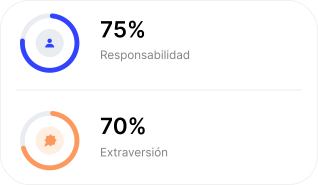
    This assessment measures five major personality traits: openness to new experiences, conscientiousness, extraversion, agreeableness, and emotional stability. It is ideal for understanding a candidate’s social adaptability, stress management, and cultural fit, especially in roles that require a high level of interpersonal interaction, such as customer service, sales, or human resources.


Beyond Recruitment: How to Use Psychometric Assessments in Other Stages of the Employee Lifecycle

Psychometric assessments are not only useful for selecting talent. They are also a key tool for developing and retaining employees. Here we show you how to apply them strategically at other stages:

1. Development and Training

By applying psychometric assessments to your current team, you can:

  • Identify skill gaps
  • Customize training plans
  • Identify improvement opportunities in leadership, communication, or problem-solving skills.

Example: A personality assessment can reveal that an employee with strong technical potential needs support in developing interpersonal skills before they can effectively lead a team.

2. Succession Planning

Assess employees with growth potential to determine whether they are ready to take on greater responsibilities. Assessments can help you:

  • Identify leadership skills
  • Measure learning ability and adaptability
  • Identify compatibility with new challenges

3. Work Environment and Organizational Culture

By applying group assessments, you can understand how your team is structured:

  • Is there a balance between analytical and creative profiles?
  • What work styles predominate?
  • Are there areas of cultural friction?

This allows you to make informed decisions regarding restructures, new hires, and work dynamics.

4. Reassessment Before Internal Transfers

If you are considering moving someone to a different department or assigning them a new project, you can use assessments to confirm that their profile is suited to the new environment.

Psychometric Assessments – Examples

Psychometric assessments can be adapted to different profiles and hiring objectives. Below, we present specific examples of how they are used in real selection processes to evaluate different types of candidates, based on the competencies required for the role.

Example 1: Psychometric Assessment for a Software Developer

  • Types of assessments applied:
    • Programming Technical Test
    • Logical Aptitude and Abstract Reasoning Test
    • Work Personality Test
  • What does it measure?
    The candidate’s ability to solve real-world problems through functional code, logical thinking, learning speed, and teamwork style.
  • Objective of the assessment: Ensure that the candidate not only has the necessary technical knowledge, but also the ability to adapt to collaborative environments and handle complex challenges under pressure.
  • Example role: Backend Developer in a fintech company.

Example 2: Psychometric Assessment for a Sales Executive

  • Types of assessments applied:
    • Personality Test
    • Emotional Intelligence Test
    • Motivation Assessment
  • What does it measure?
    Social skills, rejection tolerance, ability to influence and negotiate, stress management, and internal motivation.
  • Assessment objective: Hire professionals with high adaptability, a results-oriented mindset, and strong persuasion skills that enable them to maintain performance even in highly competitive environments.
  • Example role: B2B Sales Representative in a technology company.

Example 3: Psychometric Assessment for an Operations Manager

  • Types of assessments applied:
    • Leadership Test
    • Intelligence Test
    • Personality Test Adapted for Decision-Making
  • What does it measure?
    Planning ability, strategic thinking, effective leadership, task delegation, and adaptability to changing environments.
  • Assessment objective: Validate that the candidate can lead diverse teams, implement long-term strategies, and make decisions aligned with the company’s objectives.
  • Example role: Regional Operations Manager in a logistics company.

Example 4: Psychometric Assessment for Interns or Trainees

  • Types of assessments applied:
    • General Aptitude Test
    • Workplace Psychometric Test Simulator
    • Attention to Detail Test
  • What it measures: Development potential, cognitive agility, concentration ability, and compatibility with the organizational culture.
  • Assessment objective: Identify young talent with high learning capacity and growth potential within the organization.
  • Example role: Marketing or Analytics Intern.

Example 5: Leadership Assessment-Based Evaluation

  • Type of assessment applied: Leadership Assessment
  • What it measures: The candidate’s ability to lead teams, set clear priorities, make strategic decisions, and align their actions with measurable results. This assessment also evaluates key competencies such as planning, goal management, organizational focus, and strategic execution.
  • Assessment objective: Determine whether the candidate can align their day-to-day work with strategic objectives, positively influence their team, and maintain a systematic, results-oriented approach.
  • Example roles: Project Coordinator, Strategic Planning Analyst, Operations Manager.

Why Incorporate Psychometric Assessments into Your Hiring Process?

In an increasingly competitive job market, companies can no longer afford to hire based on intuition alone. Workplace psychometric assessments provide a reliable and objective way to evaluate candidates beyond their résumés, identifying the skills, aptitudes, personality traits, and cognitive abilities that best align with the requirements of each role.

When applied correctly, these assessments help reduce hiring errors, lower employee turnover, improve performance from day one, and build stronger, more cohesive teams.

Evalart brings this technology to your organization through a comprehensive catalog of psychometric, technical, and customizable assessments. In addition, it offers a simple, fast, and reliable process designed for recruiters who need accurate, actionable results.

Evalart Features: Precision, Variety, and Technology for Smarter Hiring

Evalart has developed a robust, flexible platform designed to meet the challenges of modern recruitment. Its key features include:

  • Library of psychometric and technical assessments: Evalart offers one of the most comprehensive assessment libraries on the market. It includes evaluations such as DISC, Big Five, programming and technical skills assessments, reasoning tests, leadership evaluations, and many more. The library is continuously expanding to meet the evolving needs of the job market.
  • Multiple question formats: Evalart supports a variety of assessment formats, including multiple-choice questions (with text or images), open-ended responses, and hands-on coding simulations. This flexibility enables more accurate evaluations tailored to the specific requirements of each role.
  • Advanced fraud detection: Evalart incorporates advanced anti-fraud monitoring technologies that detect suspicious behavior during assessments, ensuring reliable, secure, and transparent results.
  • Detailed, visual reports: Results include intuitive charts, role-based benchmarks (such as “Advanced Java Developer”), and a comprehensive breakdown of the skills assessed. This enables more informed, objective, and data-driven hiring decisions.
  • Conduct real-world technical assessments: For technical roles, Evalart offers coding tests in pseudocode and programming languages such as Python and Java, automatically evaluating the logic, accuracy, and efficiency of the submitted code.

Evalart and Your Selection Processes: Efficiency, Scalability, and Customization

Beyond the assessment itself, Evalart improves your entire recruitment process workflow:

  • Ease of use and multilingual support: The platform is available in Spanish, English, and Portuguese, with a clear interface for both administrators and candidates.
  • API integration: Evalart can connect with your internal tools through its API, allowing you to automate everything from sending tests to collecting results.
  • Test builder: This feature allows you to create customized assessments from scratch or modify existing versions, adapting tests to your internal needs.
  • High level of customization: From welcome messages to final reports, Evalart allows you to customize many aspects of the candidate and recruiter experience.

Explore our complete catalog and transform your selection process

✅ More than 250 tests available
✅ Detailed and customizable reports
✅ Anti-fraud monitoring and identity verification
✅ Real-time results

Frequently Asked Questions About Workplace Psychometric Tests

Are psychometric tests reliable?
Yes, as long as they are properly designed and validated by psychometrics experts. Evalart uses tests developed by psychologists and specialists, supported by statistical evidence and continuously calibrated to maintain their validity and reliability.

How long do psychometric tests take?
It depends on the type of test. Some aptitude assessments can take between 15 and 30 minutes, while more comprehensive tests, such as personality or intelligence assessments, can take up to an hour. Evalart allows you to adjust the duration according to your needs.

Can I combine different types of tests?
Yes. In fact, this is the most recommended approach. You can create customized workflows that include personality, intelligence, technical knowledge assessments, and more, to gain a comprehensive view of the candidate.

What happens if a candidate tries to cheat?
Evalart offers fraud protection mechanisms, such as camera monitoring, identity verification, and automatic alerts for suspicious behavior.

How do you know if a test is suitable for the position?
Evaluate which competencies are key for the role and identify which type of test measures them best. You can also use our recommendations within the catalog to guide you.

Can these tests be applied to current employees?
Yes, and this is a strategic approach that many companies are incorporating. See the following section for more details.

Other similar news articles

How to evaluate customer service in selection processes?

Customer service is one of the most important aspects of any business. The way a company treats its customers can have a significant impact on…

Read More
Candidate Reference Fraud: Understanding & Prevention

Candidate Reference Fraud: Understanding & Prevention The art of securing a new job often hinges on the strength of your references. For job seekers, it's…

Read More
How to Test SharePoint Skills in Interviews | Microsoft SharePoint Interview Questions

How to Test SharePoint Knowledge in Interviews Recruiting the right talent for technology roles requires not just assessing experience but also testing relevant skills effectively.…

Read More