How to Interpret Psychometric Tests

Interpreting Psychometric Tests: A Guide for Recruiters

In modern recruitment processes, psychometric tests are a key tool for better understanding candidates. Applying them with scientific rigor gives us objective data on personality, reasoning, attention, and other important aspects. However, obtaining results is only half the process: knowing how to interpret those results is what truly makes the difference between a good hire and a wrong decision.

In this guide, we will look at how to interpret psychometric test scores, what they really mean, common mistakes you should avoid, and how to integrate these results with interviews, references, or other assessments to make better selection and talent development decisions.

Application and Interpretation of Psychometric TestsAplicación e interpretación de pruebas psicométricas

Psychometric tests measure psychological characteristics that are difficult to evaluate solely through interviews or resume reviews. Among the aspects they typically measure are:

  • Logical reasoning and problem-solving ability
  • Personality style and behavioral preferences
  • Attention to detail and accuracy
  • Verbal or numerical aptitudes

When you receive the results, you will see numerical scores, categories, or profiles. To interpret them correctly, keep the following in mind:

1. Understand the scoring scale

Tests usually provide:

  • Percentile scores: Indicate how well the candidate performed compared to a reference population.
  • Normed scores: Adjusted for different demographic groups or roles.
  • Category classifications: For example, “high,” “medium,” or “low.”

Not all tests use the same scales, so always read the instrument’s instructions before interpreting.

2. Relate the scores to the job profile

A high score in logical reasoning may be ideal for technical roles, but less critical for positions where creativity or communication are more important. That is why it is key to compare the results with the actual job description.

3. Analyze patterns, not just individual values

A single isolated score does not tell the whole story. Look for relevant combinations. For example, a candidate with high emotional stability and good reasoning may excel in high-pressure roles, even if their attention to detail score is not as high.

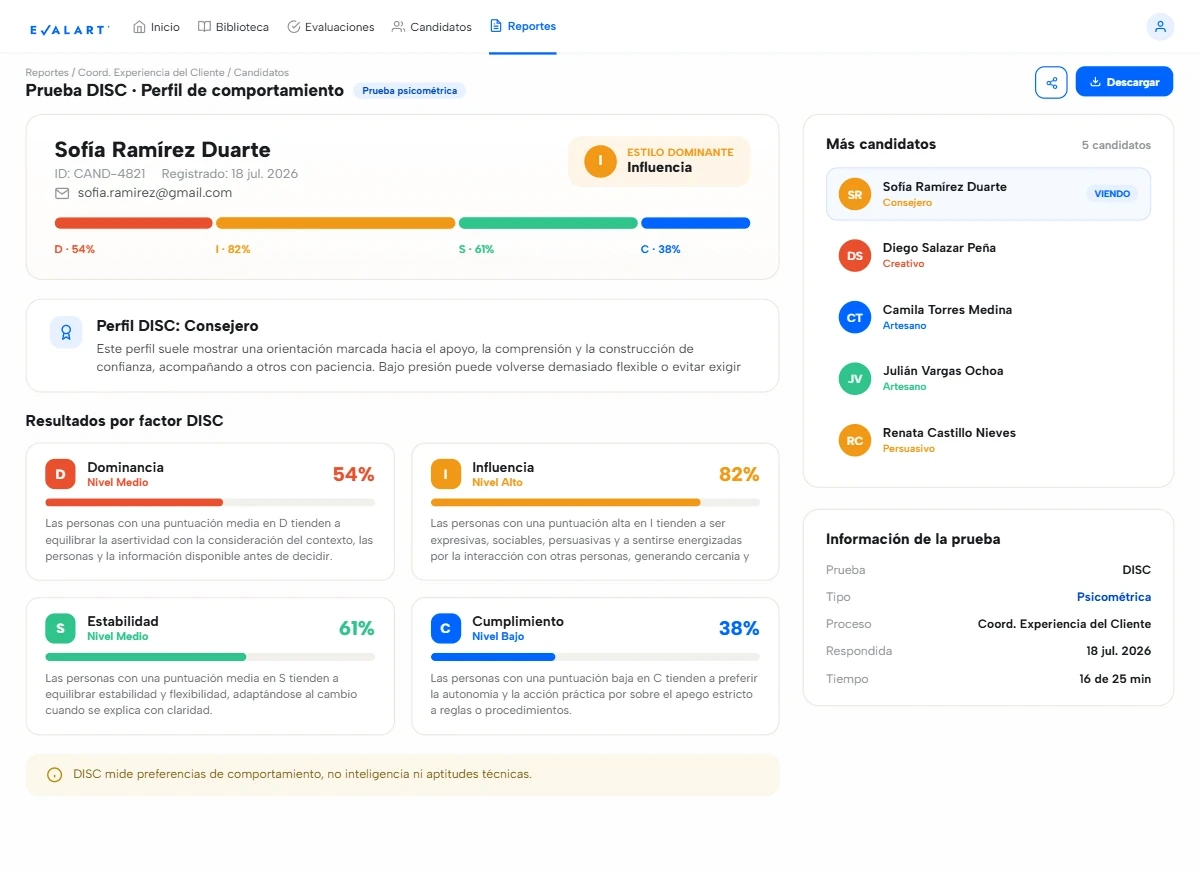
A tool like Evalart facilitates this analysis by generating comprehensive and comparative reports showing profiles, trends, and interpretation suggestions.

Discover how it Works

How to answer psychometric tests well?

Although the focus of this article is interpreting results, it is useful to understand how the candidate can perform better on these tests. This also helps you evaluate the quality of their results and determine if there were biases in their application:

1. Read each instruction carefully

Many tests have time limits or specific instructions that, if not followed, affect the validity of the result.

2. Avoid “socially desirable responding” strategies

Some people try to “guess” the answer they think the evaluator wants to hear. Modern psychometric tests usually have mechanisms to detect inconsistency or forced answers.

3. Maintain concentration during the test3. Mantener concentración durante la prueba

Fatigue or distraction reduces the quality of the results. Ensure that candidates take it in a quiet environment or with proper supervision if it is online.

A laptop displaying data visualizations, including charts and tables, placed on a sofa. Neutral environment with soft lighting.

How do you fail a psychometric test?

It is important to clarify that psychometric tests are not designed to be “passed” or “failed” like an academic exam. Instead:

  • Results are interpreted as measurements of tendencies, styles, or skills, not as a pass/fail evaluation.
  • A “low” score in one dimension does not mean the candidate is disqualified per se, but rather that this dimension may be less developed compared to the reference population or what the role demands.
  • Beyond scores, what matters is how those results align with the needs of the position and your organization’s culture.

For example, a profile with low stress tolerance does not mean they “failed,” but it could indicate that they require an environment with less pressure or that they should be evaluated more deeply in situational interviews.

Common interpretation mistakes and how to avoid them

Interpreting psychometrics can be challenging. These are frequent mistakes and how to avoid them:

Reading results without context

No todos los candidatos vienen del mismo trasfondo. Usa descriptores y normativas del instrumento.

Always interpret with the specific role in mind.

Using results as the sole criterion

No test should be the sole basis for deciding.

Combine results with interviews, references, and performance on practical tasks.

Ignoring the quality of the test application

Results obtained under distraction, pressure, or without supervision may not be reliable.

Ensure optimal application conditions and verify validity.

Integration with interviews, references, and other assessments

The interpretation of psychometric tests should be part of a broader selection and development process. The important thing is to have a platform that allows you to do it easily. Here are some integration recommendations:

1. Use the results to guide interviews

If a test shows low openness to experience, you can ask in the interview about how the candidate has handled new or unexpected situations.

2. Contrast with professional references

Former managers can confirm patterns observed in the tests, such as attention to detail, teamwork, or stress tolerance.

3. Relate it to practical tests

If a test indicates strong logical reasoning, you can validate it with a technical or situational exercise in your process.

Evalart allows you to combine all these assessments into a single workflow, generating actionable reports, comparative dashboards, and clear recommendations.

Start with a free trial

Two people collaborate over charts and graphs on a table. Hands point at the data, suggesting teamwork and analysis in a business environment. The colorful visual elements create a focused atmosphere.

Interpretations that add real value

Interpreting psychometric tests is much more than reading a number or a category label. It is about understanding the meaning behind each score, relating it to the real demands of the job, and using it as one more input for smart hiring.

When you combine psychometrics with well-structured interviews, professional references, and practical assessments, your selection process becomes more objective, predictable, and effective. The key is to see each result as a piece within a mosaic of information, not as an absolute truth.

Explore all available tests

Other similar news articles

How important is the search for candidates?

The current talent market is highly competitive, and while, for some positions, there may be many qualified people to fill them, for others, it is…

Read More
The 10 best books to read in 2022 if you work in Human Resources

HR books are a rich resource for learning the ins and outs of the profession at only a fraction of what a more formal HR…

Read More
Mastering Teacher Interview Questions: A Guide for Hiring Managers

Mastering Teacher Interview Questions: A Guide for Hiring Managers Hiring the right teacher is crucial for maintaining the quality of education and fostering a positive…

Read More