Knowledge tests for personnel selection: a practical guide
Personnel selection is one of the most critical stages in talent management. Beyond reviewing resumes and conducting interviews, successful organizations apply knowledge tests to know with certainty if a candidate has the necessary skills for a specific position. These assessments provide objective data that complement other selection methods and help make decisions with greater precision.
In this article, we explain what knowledge tests are, how they differ from other assessments, when to use them, examples according to key areas, and how to interpret them to elevate the quality of your recruitment.

What are knowledge tests for personnel selection?
Knowledge tests are assessments designed to measure what a candidate knows about a specific area or concrete tasks related to the job. Unlike psychometric tests or interviews, which analyze behavioral styles or general competencies, these tests focus on specific technical capabilities.
Applying them allows you to:
- Identify those who truly master key content.
- Filter candidates based on evidence and not just perception.
- Compare profiles against each other using objective criteria.
These tests are usually part of a comprehensive selection strategy, where they are combined with interviews, references, and other tools to get a complete picture of the candidate.
What types of tests are used in personnel selection?
Personnel selection tests can vary greatly depending on the role and sector, but generally, they are divided into three broad categories:
1. Technical knowledge tests
They evaluate the mastery of topics specific to the position, such as software, accounting rules, specific tools, methodologies, or processes. For example:
- Excel test for administrative or financial roles.
- Programming test for developers.
- Labor legislation test for human resources.
2. Reasoning and logic tests
They measure cognitive skills such as information analysis, problem-solving, and decision-making. These tests are useful for profiles that require critical thinking.
3. Area-specific tests
There are also assessments by sector or function, such as sales, customer service, or logistics, where real work situations are simulated to see how the candidate responds.
Beyond these, many companies combine these tests with psychometric assessments, attention-to-detail tests, or personality assessments to get a complete view of a person’s potential.
When are they most effective?
Estas pruebas son críticas en cargos donde el error técnico tiene un costo alto. No importa si es un perfil administrativo que debe manejar bases de datos o un desarrollador de software; si la persona no tiene el conocimiento base, la capacitación será larga y costosa.
Therefore, integrating personnel selection tests at the beginning of the process allows you to filter out “paper experts” and keep only the talent that has the ability to produce from their first day in the office.
At the end of the day, the goal is simple: make decisions based on evidence, not promises. Using technology to validate knowledge is the fastest way to ensure that every new hire is a safe investment for the company.
What is an example of a job knowledge test?
Suppose you are recruiting for an administrative assistant role. A job knowledge test could include:
- Identifying the parts of an accounting document.
- Interpreting information from a data table.
- Solving simple schedule organization exercises.
- Understanding and applying operational instructions.
This type of test allows you to verify if the candidate can perform from day one, reducing the gap between what the CV says and what they actually know how to do.

The importance of selection tests
Knowledge tests matter for several reasons:
- Objectivity: they avoid subjective judgments based on impressions or sympathies.
- Efficient comparison: they make it easy to rank candidates according to actual scores.
- Time-saving: by filtering before in-depth interviews or tests.
- Better quality of hire: they reduce selection errors by relying on evidence.
They do not replace an in-depth interview, but they do provide a layer of reliability that cannot be obtained solely with conversations or resume reviews.
A robust selection process does not depend on a single tool. To get a complete view of talent, leading companies combine different assessments:
- Technical Knowledge Tests: Validate specific hard skills, such as advanced Excel, programming languages, or legal regulations.
- Aptitude Tests: Measure learning capacity and logical reasoning. They are fundamental to knowing if someone can adapt to new challenges.
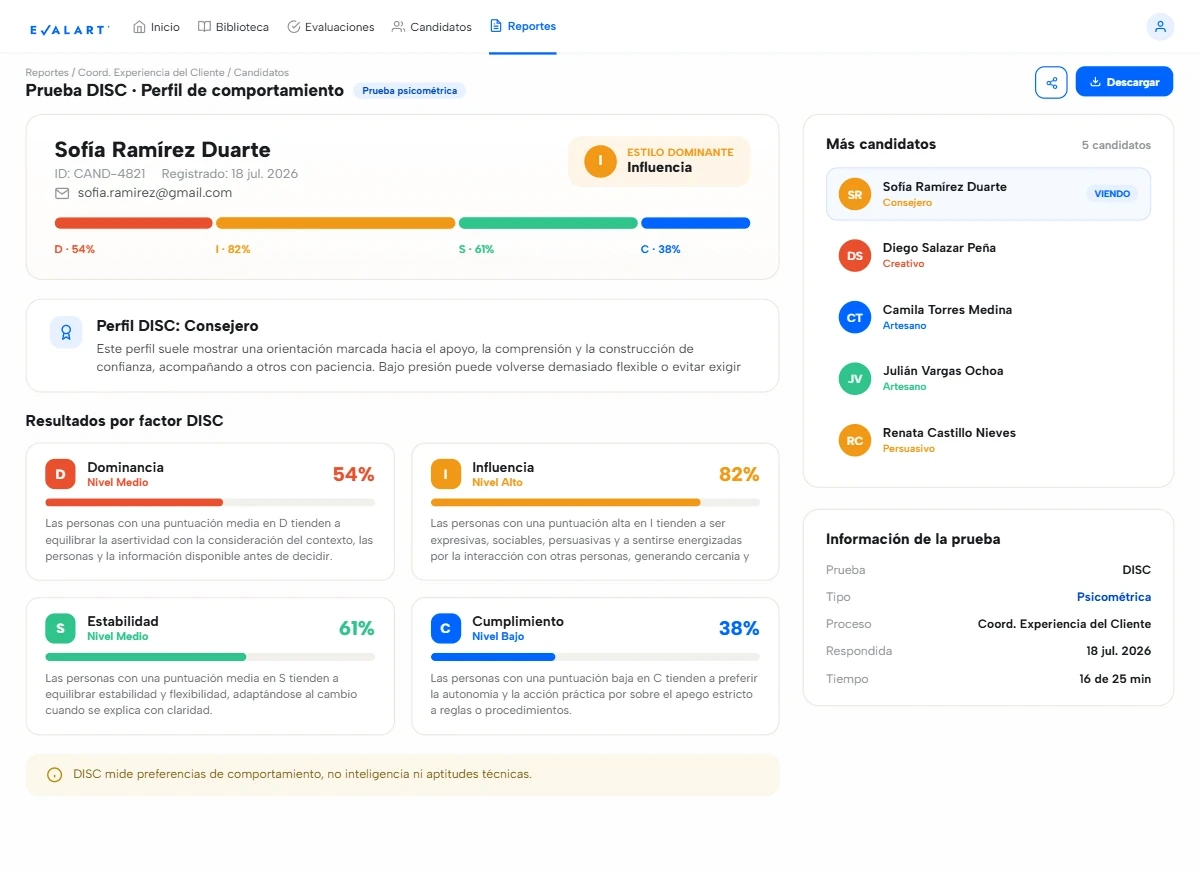
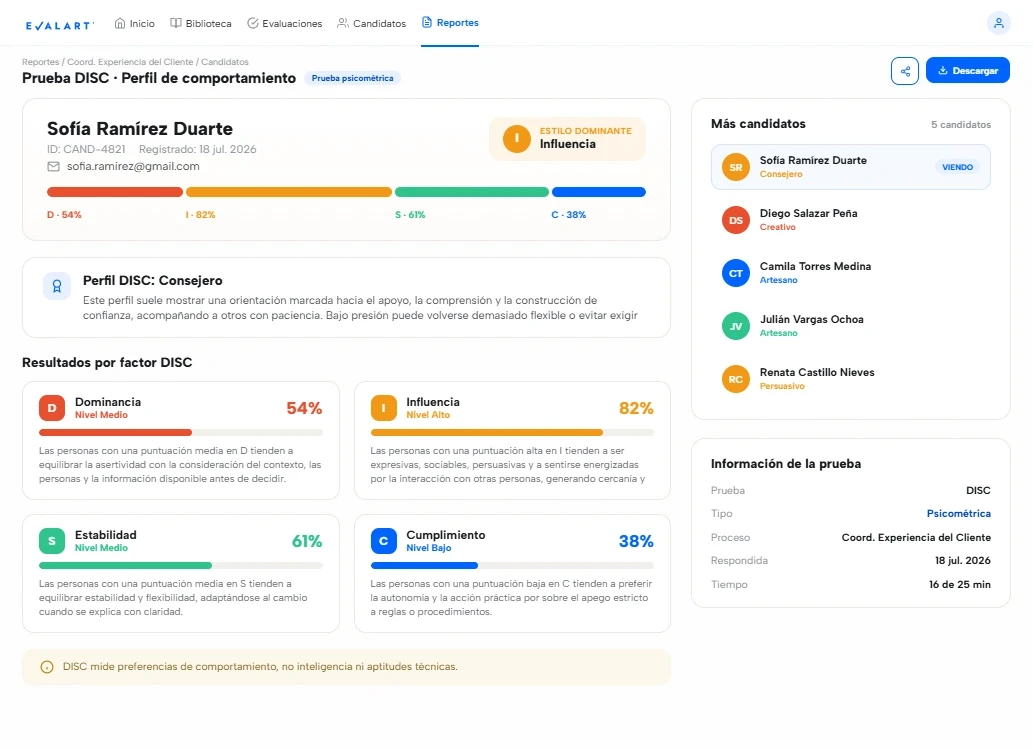
- Personality Assessments: Tools like the DISC test or the Big Five that help predict behavior and cultural fit.
A practical example: What does a real test look like?
Imagine you are looking for a data analyst. An effective knowledge test will not ask “if they know SQL,” but will present them with a real database to extract information within a time limit. These types of technological functionalities allow you to detect if the candidate has the speed and accuracy that your company’s pace demands.
What personnel selection tests measure
Tests can evaluate different dimensions, such as:
- Technical knowledge: mastery of tools or concepts of the role.
- Logical reasoning: ability to solve problems or make decisions.
- Process comprehension: ability to understand internal procedures.
- Data management: interpretation of numerical or visual information.
- Critical thinking: ability to analyze complex situations.
In conjunction with other tools, this measurement helps identify who truly meets the requirements of the position.
How to combine them with other stages
Although they are very useful, knowledge tests work best when integrated with other selection stages. For example:
- Before a personalized interview to focus the conversation on critical areas.
- After a psychometric test to delve into soft skills.
- In combination with references to verify consistency in performance.
Platforms like Evalart allow you to integrate knowledge tests within automated selection processes, with results that can be compared and reviewed from a single dashboard, along with other assessments that help make better decisions.
👉 Discover all its capabilities here
Knowledge tests for personnel selection bring clarity, objectivity, and precision to candidate evaluation. When designed and interpreted correctly, they allow you to filter profiles based on real results, reduce biases, and accelerate talent selection.
If you want to take your selection process to another level, Evalart allows you to apply tests, manage the entire recruitment flow, and obtain actionable reports from a single platform.