Top Personality Tests for Personnel Selection: Comparison and Benefits


The recruitment and personnel selection process is crucial for most companies around the world, since it requires a lot of time and resources to find the right candidate for a given position. However, with advances in technology, these processes are being simplified thanks to personnel selection tests that help efficiently screen candidates.
Hiring the right talent isn't just a matter of experience and technical skills. A candidate's personality influences their performance, their integration into the team, and their adaptation to the company culture.
For this reason, many organizations use personality tests for personnel selection. These assessments make it possible to analyze traits such as communication, leadership, emotional stability, and how a person faces challenges.
What is the best personality test for hiring? In this article, we'll compare three of the most widely used tests in recruitment: DISC, the Big Five, and MBTI, explaining when and how to apply them to improve talent selection.
If you're looking for a comprehensive solution to assess candidates, check out our Personnel Selection Tests.
Why Are Personality Tests Important in Selection?
Personnel selection tests are a systematic and standardized way of assessing the qualities of candidates applying for a job. The company sets exercises or tests to measure aspects such as candidates' personality, cognitive abilities, knowledge, and behaviors.
This makes it possible to obtain objective and reliable information about prospective employees' abilities, experience, and knowledge. These tests have evolved into a valuable tool for employers, giving them more information about candidates before making a decision.
Beyond technical skills, every position requires certain behavioral competencies. A leader must be proactive and strategic, while a data analyst needs patience and attention to detail.
Personality tests help predict a candidate's performance in key areas such as:
Fit with organizational culture: Identify whether a candidate shares the company's values and dynamics.
Stress management and adaptability: Assess how they respond to challenges or changes.
Teamwork and leadership: Determine whether their work style is compatible with the team.
Decision-making and problem-solving: Analyze their ability to handle difficult situations.
Using these tests in personnel selection makes it possible to make data-based decisions and reduce the margin of error when hiring.
Top Personality Tests for Personnel Selection
Hiring assessments are classified into general categories in order to gather critical information to determine candidates' fitness for a specific position or company.
Not all personality tests measure the same things or serve the same purposes. Some focus on communication and teamwork, while others analyze a candidate's psychological profile in depth. The following are the main tests for getting a complete picture of a candidate.
DISC: Assessing Communication Style and Teamwork
The DISC test classifies people into four categories based on their behavior in the workplace:
Dominance (D): Results-oriented, direct, and competitive people.
Influence (I): Communicative, sociable, and persuasive.
Steadiness (S): Collaborative, patient, and reliable.
Compliance (C): Analytical, detail-oriented, and organized.
This test is useful for identifying how a person relates to others and how they respond in common workplace situations.
When to use it: It's ideal for assessing candidates in areas such as sales, customer service, and leadership, where interaction and quick decision-making are key.
More information about the DISC Questionnaire
Big Five: Comprehensive Personality Assessment
The Big Five Test, also known as the Five Factor Model, measures five fundamental dimensions:
Openness to experience: Creativity and innovation.
Conscientiousness: Organization and discipline.
Extraversion: Sociability and energy.
Agreeableness: Empathy and cooperation.
Emotional stability: Stress management and resilience.
This test is one of the most comprehensive and scientifically validated tools for assessing personality in the workplace.
When to use it: It's especially useful for selecting candidates for leadership, innovation, and team management roles.
More information about the Big Five Test
MBTI: Identifying Strengths and Work Preferences
The MBTI (Myers-Briggs Type Indicator) classifies people into 16 personality types based on four dimensions:
Extraversion vs. Introversion
Sensing vs. Intuition
Thinking vs. Feeling
Judging vs. Perceiving
This test doesn't measure skills or competencies, but rather behavioral preferences and individual strengths.
When to use it: It's ideal for coaching, career development, and talent management, helping assign strategic roles within a team.
Which Test Should You Choose Based on the Role?
Each assessment has a specific purpose. Choosing the right one depends on the type of position and the competencies you want to measure.
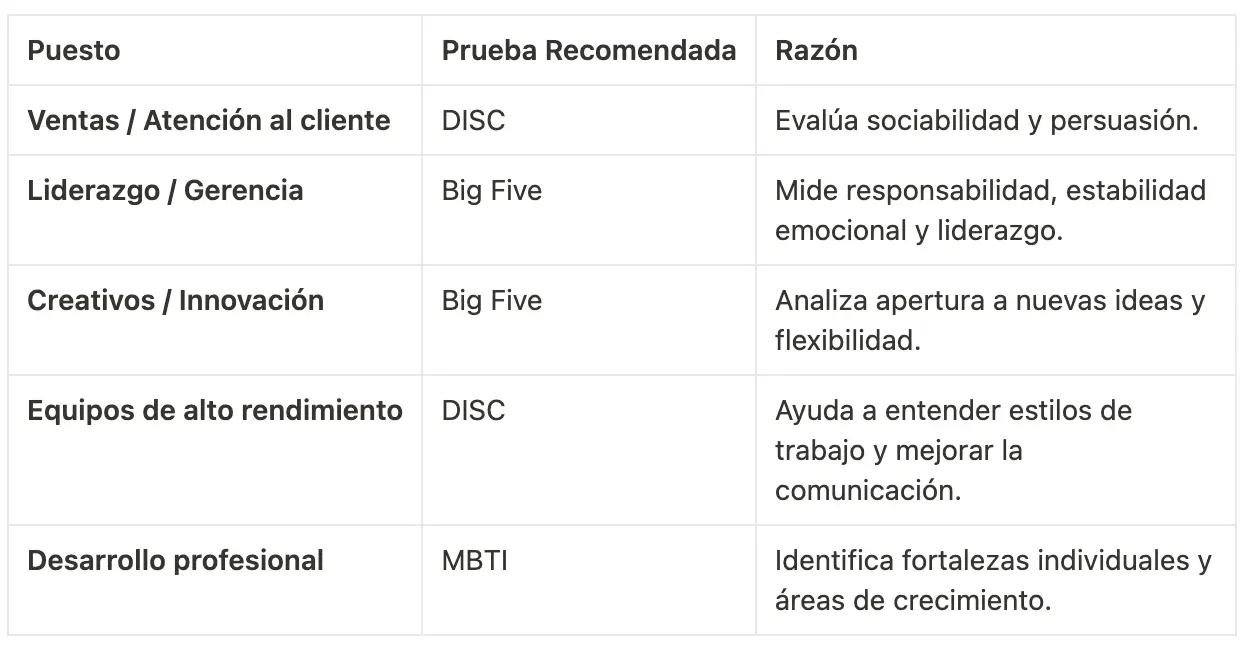
For more thorough selection processes, many companies combine these tests with technical assessments and structured interviews.
How to Implement Personality Tests in Your Selection Process
To get the most out of these assessments, it's important to follow a structured process:
Define which competencies you need to measure for each position.
Select the most suitable test based on the skills and behaviors you want to assess.
Apply the tests early on in the selection process.
Analyze the results together with interviews and technical tests to make better-informed decisions.
Use reliable platforms that offer detailed, easy-to-interpret reports.
These tests not only optimize recruitment, but also help build teams that are more aligned with the organizational culture.
Personality tests for personnel selection are key tools for assessing a candidate's compatibility with the team and the company.
While DISC, the Big Five, and MBTI are the most widely used, the best choice will depend on the type of position and the specific needs of the hiring process.
Applying these tests helps you make more informed decisions and reduce staff turnover, building more productive and balanced teams.
To assess your candidates with the best tools, check out our platform and optimize your hiring process.
Ready to improve your hiring process?
Start using psychometric and technical tests today, at no cost.